2023 SOIL LAND JUDGING CONTINUES TO GROW

377926027_6717112351737873_3062099214969120942_nCONGRATS to Clarksville High FFA team #1 on FIRST place!
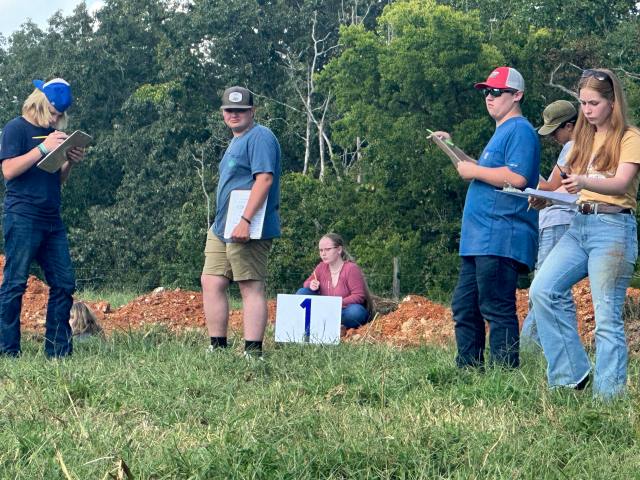
The Soil/Land Judging Contest continues to grow every year! Big thanks to Austin Peay State University for co-hosting the 2023 contest! UT TSU Montgomery County Extension, USDA-NRCS Soil Scientists and Soil Conservationists, USDA Earth Team Volunteers, Kiwanis Club of Clarksville, TN, TDA Watershed Coordinator, Montgomery Farm Bureau Women, Stewart County Soil & Water Conservation District, and Robertson County Soil & Water Conservation District employees came together to work with high school students studying agriculture and conservation for both Montgomery and Robertson Counties. 42 students competed in a local practice round before regionals late September.  Next year’s local contest will be open to additional surrounding counties in order to help students prepare in the area of soils knowledge and how soil and its classifications, abilities and conservation is vital to our survival.
WE SO APPRECIATE OUR AG TEACHERS WHO MAKE THIS POSSIBLE!!

1st place – Clarksville High FFA Team 1

2nd place – Clarksville High FFA Team 2

3rd place – Montgomery Central FFA

1st place Highest Individual Score – Noah, CHS Team 2

2nd place Highest Individual Score – Lish, CHS Team 1

3rd place Highest Individual Score – Ray, MCHS Alternate

4th place Highest Individual Score – Lane, NWHS alternateimage000002

received_1038933240474104378017063_1037218447733189_1902784647328984721_n377918406_844753523530292_2853677811435611294_n377926027_1029060094783832_1507961730596423966_n

Posted in Uncategorized | Leave a comment

COME WORK WITH US!

USDA – NRCS Soil Conservationist positions open – APP DDL AUG 25!!

Work outside, work inside, see nature at its best, assist conservation on the ground, give technical advice, conservation planning and financial assistance! Get paid to give back 😉

A vacancy announcement for six GS-457-5/7/9 Soil Conservationist positions has been posted on USAJobs.

The TN recruitment is for the following locations:

  • Union City
  • Lexington
  • Clarksville
  • Springfield
  • Madisonville
  • Morristown

The announcement opened August 14th and will close on Friday, August 25th.

Announcement number: NRCS-23-12087795-DE-NW-BC

https://www.usajobs.gov/job/742815800#

csp field
Posted in Uncategorized | Leave a comment

Tennessee announces Conservation Stewardship Program 30-day deadline extension

Natural Resource Conservation Service – Tennessee has announced an extension to the 2023 Conservation Stewardship Program (CSP) Classic and Inflation Reduction Act application deadline. Tennessee agricultural producers who wish to be considered for the current fiscal year funding should apply by Monday, September 11, 2023.

pollinator field 2021Through CSP, Natural Resource Conservation Service helps farmers and ranchers earn payments for maintaining their current level of conservation across their entire operation. CSP provides the opportunity to expand their conservation activities by adopting new technologies and management techniques. The program provides many benefits including increased crop yields, decreased inputs, wildlife habitat improvements, and increased resilience to weather extremes. CSP is for working lands including cropland, pastureland, rangeland, nonindustrial private forestland, and agricultural land under the jurisdiction of a tribe. Farmsteads and other associated agricultural lands are also included. CSP also provides specific support for organic and transitioning to organic producers.

CSP is a program made for farm operators. To be eligible, contract participants must meet Farm Bill Program eligibility in conjunction with the Farm Service Agency, including meeting the highly erodible land and wetland compliance requirements and the adjusted gross income limits.

The application deadline is September 11, 2023, however through the streamlined application and contract approval approach, applications will be assessed and ranked as they are submitted to local USDA Service Centers. NRCS Tennessee will be utilizing an ACT NOW approach. Based on the availability of funds, applications with a score greater than one point will be preapproved once assessed and ranked until funds have been expelled.

Interested producers looking to increase their level of conservation across their operation in Montgomery county can apply for CSP within our office – 25 Jefferson St, Clarksville or by calling 931-368-0252 x 2.

USDA is an equal opportunity provider, employer and lender.

Posted in Uncategorized | Leave a comment

2023 HINTON SCHOLARSHIP RECIPIENTS SELECTED

CONGRATULATIONS to the 2023 David E. Hinton Scholarship recipients, Haley Foster and Hagen Albright! Haley is a sophomore majoring as a veterinarian technician and Hagen will begin his college journey as a ag-business major!

winner H Foster w board

l to r: Richard Davis, Cody Greene, Johnny Head, Haley Foster, Paul McKinney, and Jim Alley.

The Montgomery County Soil & Water Conservation District is proud to support agricultural endeavors in the classroom!  Students in agriculture and conservation are our future!

winner H Albright w board

l to r: Richard Davis, Cody Greene, Johnny Head, Hagen Albright, Paul McKinney, and Jim Alley.

Check out our EDUCATION page for more information and when to apply for this annual scholarship.

Posted in Uncategorized | Leave a comment

INFORMATIVE TIMELY TIPS FOR GRAZING

Summer Mowing, Controling Flies, and Pasture Condition Scoring BY GREG BRANN

“…The common question is, “Should I mow, and if so, how high?” Of course, it depends; mowing costs around $25/ac, so we need to be sure the cost can be recouped. Grazing at high densities of around 40,000 pounds or higher of livestock per acre lays down a lot of the grass, greatly reducing or eliminating the need for mowing. Laying down residual grass also benefits soil health, creating more ground cover and feed for underground livestock. A rule of thumb is to keep light to desirable plants and shade out undesirable plants. Another commonly agreed practice is to control vegetation when weeds occupy 20% or more of a pasture. If I am going to mow, I prefer to mow after grazing and not mow over 20% of the total pasture acreage at one time. Mowing low has more impact on weeds, but remember another principle, manage for what you want, not what you don’t want. Another rule of thumb is to mow 2” into the leaf of grass. Typically, I mow to a 5” height. If the pasture is mostly weeds with little desirable grass, you’ll want to mow low but don’t mow lower than 3” on tall fescue-dominated pastures.” – full article, Greg Brann Timely Tips

Greg Brann, former USDA-NRCS Grazing Lands Specialist, currently Synergistic Grazing Management Consultant shares a wealth of knowledge and information on his site HERE that is worth the read!

brann

Posted in Uncategorized | Leave a comment